My research profile
I study how political institutions can make democracy more accountable, resilient, and responsive to citizens. My research sits at the intersection of political science, constitutional law, human rights law, public administration, and security studies, with a particular focus on independent oversight institutions, that is, fourth-branch institutions.
What distinguishes my research is its close connection to practice. Before joining academia, I spent more than a decade working in national and international public institutions. Working alongside policymakers, public officials, and oversight bodies across Europe, Africa, and Asia has shaped the questions I ask as a researcher and the way I approach them. I am interested not only in how institutions are designed, but whether they deliver on their constitutional and statutory promise.
Across my work, I seek to bridge theory and practice by developing interdisciplinary approaches to institutional design, democratic governance, and the protection of human rights. Whether examining democratic backsliding, authoritarian appointments in public administration, accountability in the security sector, or the constitutional role of independent institutions, my goal is to produce research that is both theoretically sound and relevant to contemporary governance challenges.
Research in progress
My current research agenda focuses on two interconnected strands:
(1) Constitutional promises, normative expectations, and institutional delivery: I examine how public institutions translate constitutional promises into practice and how their performance can be assessed against the normative expectations embedded in constitutional design. Within this strand, I am particularly interested in the nature and strength of the oath of office, exploring its potential role as an instrument of liability, responsibility, and accountability.
(2) The challenges of democratic recovery and institutional renewal: I study how governments emerging from authoritarian rule can re-democratize the state and overcome the authoritarian enclaves that persist within public institutions. This research explores the institutional legacies of authoritarianism, including entrenched personnel, practices, and informal networks.
My research outputs
Below is an overview of my recent peer-reviewed publications, organized into three main categories: research monographs (books), book chapters, and journal articles. For publications available in open access, this is clearly indicated. For other publications, where available, links are provided to the publishers’ websites, along with the option to download the final peer-reviewed version of the work (Accepted Manuscript).
Books

Ombuds Institutions for the Armed Forces: Citizens, Uniforms and Human Rights
Routledge, forthcoming.
-
This book examines ombuds institutions for the armed forces as mechanisms of accountability, human rights protection, and democratic oversight.
The volume examines the history, institutional design, and practices of ombuds institutions for the armed forces, as well as the challenges they face across a diverse range of legal and political settings. In doing so, the book seeks to illustrate their importance within the broader ecosystem of democratic security governance, as providers of independent oversight with a unique interface to the individual and the capacity to engage with the day to day, administrative, and interpersonal dimensions of military authority. Combining desk research, comparative legal analysis, and insights from practitioner exchanges in the context of the International Conference of Ombuds Institutions for the Armed Forces (ICOAF), the book offers an analytical account of these institutions that is grounded in the contexts in which they operate and the conditions that shape their work. Furthermore, new emerging challenges are also covered, such as the pandemic, climate change, protection of the mental health of soldiers, protection against sexual abuse and exploitation, digitalization, ombuds’ role in peace support operations, and the challenges of operating in an armed conflict and in the context of democratic backsliding.
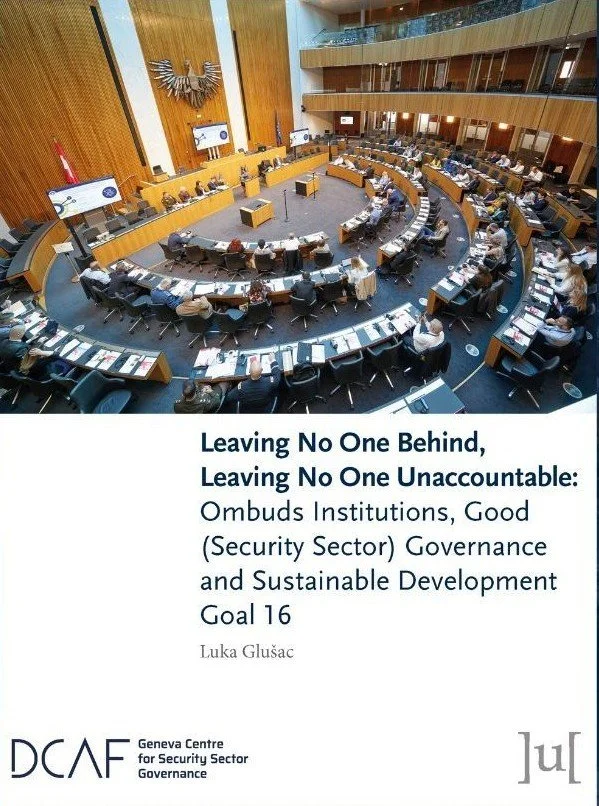
Leaving No One Behind, Leaving No One Unaccountable: Ombuds Institutions, Good (Security Sector) Governance and Sustainable Development Goal 16
DCAF and Ubiquity Press, 2023.
-
How does the nexus between security, human rights and good governance play out in the sustainable development context? Based on state-of-the-field, interdisciplinary research with a global perspective, Leaving no one behind, leaving no one unaccountable offers the first comprehensive account of the role of ombuds institutions in achieving the Sustainable Development Goals, launched by the United Nations in 2015. With their unique position in-between three branches of power, the mandate to oversee public administration (including the security sector) and protect human rights, ombuds institutions are well-placed to play an important role in national efforts to fulfil the SDGs. The book takes the specific angle by looking at SDG-16, devoted to effective, accountable and inclusive institutions, through the lens of security sector governance.
It brings granular analysis of all SDG 16 targets, demonstrating how ombuds institutions could contribute to achieving each of them. The book develops an innovative conceptual framework, by looking at both implementation and accountability. The former is captured under the title of ‘leaving no one behind’ and the latter under ‘leaving no one unaccountable’. Leaving no one behind is a central credo of the 2030 Agenda. It is highly relevant for SDG-16, as well as security sector governance, due to the centrality of the principles of responsiveness, inclusiveness and participation.
The book attests that for a number of the SDG 16 targets, ombuds institutions should primarily serve as accountability mechanisms. It argues they should work with, pressure, and make public administration accountable, in cases when the administration as the primary duty-bearer fails to protect the rights of citizens and when their actions fall short of the standards needed to achieve the SDGs.
As this book demonstrates, many SDG 16 targets are rather vague, and limited guidance exists on how to measure and achieve them, especially in fragile contexts. It thus provides guidance and recommendations to ombuds institutions and other actors on how to best support each other in achieving SDG-16. Leaving no one behind, leaving no one unaccountable is a key resource for scholars, policymakers and activists concerned with effective, accountable and inclusive institutions, and those interested in political science, security studies, human rights and development studies.
Book chapters
(2026). Glušac, L. Ombuds Institutions (pp. 184-195). In: Sandy Africa, Aries A. Arugay and Hans Born (eds), The Routledge Handbook on Security Sector Reform, Routledge.
(2024). Kochlamazashvili, M. and Glušac, L. The Public Defender (Ombudsman) of Georgia: Reaching those Furthest Behind by Protecting Conflict-Affected Populations (pp. 32-47), In: Alice Alunni and Richard Steyne (eds), The Contribution of Ombuds Institutions to Sustainable Development Goal 16 through Security Sector Governance and Reform, Geneva: DCAF.
(2019). Glušac, L. Uticaj konstitucionalizacije ombudsmana na njihovo funkcionisanje u tranzicionim državama (str. 311-326), u Biljana Đorđević (ur.), Zbornik radova sa redovne međunarodne konferencije Udruženja za političke nauke Srbije, „Konstitucionalizam i ustavni dizajn u demokratskoj recesiji“, 22-23. septembar 2018, Udruženje za političke nauke Srbije i Fakultet političkih nauka, Beograd.
(2025). De Vrieze, F. and Glušac, L. It Is Your Own Device, Make It Powerful: Parliament’s Interaction with Anti-Corruption Agencies (pp. 32-44), in Joseph Pozsgai-Alvarez and Roxana Bratu (eds), The Routledge Handbook of Anti-Corruption Research and Practice, Routledge.
(2024). Kimari, M. and Glušac, L. The Commission on Administrative Justice – Office of the Ombudsman of Kenya: Promoting Transparency and Accountability in Police Recruitment and Prison Monitoring (pp. 48-61), In: Alice Alunni and Richard Steyne (eds), Making Societies More Just, Peaceful and Inclusive through Oversight of the Security Sector: The Role of Ombuds Institutions, Geneva: DCAF.
(2019). Tepavac, T. i Glušac, L. Narušavanje podele i ravnoteže vlasti: dominacija egzekutive u Srbiji (str. 80-102), u Srđan Prodanović, Gazela Pudar Draško, Marija Velinov (prir.), Otete institucije u Srbiji: teorija i praksa, IFDT, Beograd.
Journal articles
(2026). Glušac, L. New development: Patronage police appointments in autocracies—lessons from Serbia. Public Money & Management, Taylor and Francis, http://dx.doi.org/10.1080/09540962.2026.2729401 (download here)
(2026). Glušac, L. National human rights institutions as fourth-branch candidates. Global Constitutionalism, Cambridge University Press, https://doi.org/10.1017/S2045381726100331 (open access; download here)
(2026). Glušac, L. Sensory repression: the indiscriminate use of less-lethal weapons during public assemblies, Human Rights Law Review, Oxford University Press, 26 (1), https://doi.org/10.1093/hrlr/ngaf050 (download here)
(2024). Dursun-Özkanca, O. and Glušac, L. Forming Connections between Security Sector Reform and Sustainable Development: The Potential of the Human Security Paradigm. Journal of Regional Security, University of Belgrade, 19 (1), 7-27, http://doi.org/10.5937/jrs19-46819 (open access, download here)
(2023). Glušac, L. Razvoj ideje o nacionalnim institucijama za ljudska prava: od Ženevskih smernica do Pariskih principa, Međunarodna politika, 74 (1188), 29-54, https://doi.org/10.5937/spz66-36226 (open access, download here)
(2022). Glušac, L. Universal Periodic Review and Policy Change: The Case of National Human Rights Institutions, Journal of Human Rights Practice, 14(1), 285–304, https://doi.org/10.1093/jhuman/huab055 (download here)
(2020). Glušac, L. Razlikovanje nezavisnih kontrolnih i regulatornih tela, Zbornik radova Pravnog fakulteta u Nišu, 87, 197-216, https://doi.org/10.5937/zrpfn0-24691 (open access, download here)
(2019). Glušac, L. Engagement and Political Institutions: The Case of Ombudsman, Philosophy and Society, 30(4), 493-508, https://doi.org/10.2298//FID1904493G (open access, download here)
(2019). Glušac, L. Assessing the Relationship between Parliament and Ombudsman: Evidence from Serbia (2007-2016), International Journal of Human Rights, 23(4), 531-554, https://doi.org/10.1080/13642987.2018.1513400 (download here)
(2018). Glušac, L. Local Public Libraries as Human Rights Intermediaries, Netherlands Quarterly of Human Rights, 36(2), 133-151, https://doi.org/10.1177/0924051918772968 (download here)
(2026). Glušac, L. Ex ante review of legislation: the role of national human rights institutions. The Journal of Legislative Studies, Taylor and Francis, https://doi.org/10.1080/13572334.2026.2684036 (download here)
(2025). Glušac, L. Norm Compliance and International Status: National Human Rights Institutions in Domestic and Global Politics, Politics and Governance, Cogitatio Press, 13, https://doi.org/10.17645/pag.8879 (open access, download here)
(2024). Glušac, L. O odgovornosti za postupke drugih tokom oružanog sukoba, Theoria, Serbian Philosophical Society, 67(3), 205-218, https://doi.org/10.2298/THEO2403205G (open access, download here)
(2022). Glušac, L. Razvoj ideje o nacionalnim institucijama za ljudska prava: od prve skice do Ženevskih smernica (1946-1978), Strani pravni život, 66(1), 59-74, https://doi.org/10.5937/spz66-36226 (open access, download here)
(2021). Glušac, L. A Critical Appraisal of the Venice Principles on the Protection and Promotion of the Ombudsman: An Equivalent to the Paris Principles?, Human Rights Law Review, 21(1), 2-53, https://doi.org/10.1093/hrlr/ngaa040 (download here)
(2020). Glušac, L. Criminalization as Anxious and Ineffective Response to Foreign Fighters Phenomenon in the Western Balkans. Journal of Regional Security, 15(1), 39-74, https://doi.org/10.5937/jrs15-24025 (open access, download here)
(2019). Glušac, L. The Role of National Human Rights Institutions in Post-Legislative Scrutiny, European Journal of Law Reform, 2, 72-86, https://www.boomportaal.nl/doi/10.5553/EJLR/138723702019021002006 (open access, download here)
(2018). Glušac, L. National Human Rights Institutions and Oversight of the Security Services, Journal of Human Rights Practice, 10(1), 58–82, https://doi.org/10.1093/jhuman/huy002 (download here)
(2017). Glušac, Mesto i uloga Zaštitnika građana (Ombudsmana) u procesu pristupanja Republike Srbije Evropskoj uniji, Godišnjak Fakulteta političkih nauka, 11/17, 53-72, https://doi.org/10.18485/ (open access, download here)